
Every week, another thread goes viral claiming you can make professional video ads with AI for $10. The screenshots look impressive. The production cost sounds revolutionary. And the comments are full of people asking which tool to use.
But the AI video ads cost conversation is missing something: the real math. Not the API credits per generation, but the total cost of producing an ad that actually runs in a campaign and converts.
We tracked real practitioner data from creators, ad buyers, and production studios working with Seedance 2.0, Kling 3.0, and other AI video models. Here is what the numbers actually look like.
The "$10 Ad" Math Is Wrong
The viral claim usually goes like this: one API call costs a few cents. A 15-second ad needs 3 clips. Total: under $2. Round up for iterations, and you are at $10.
That math accounts for API credits. It ignores everything else.
Here is what a real production run looks like, based on data from practitioners running actual ad campaigns:
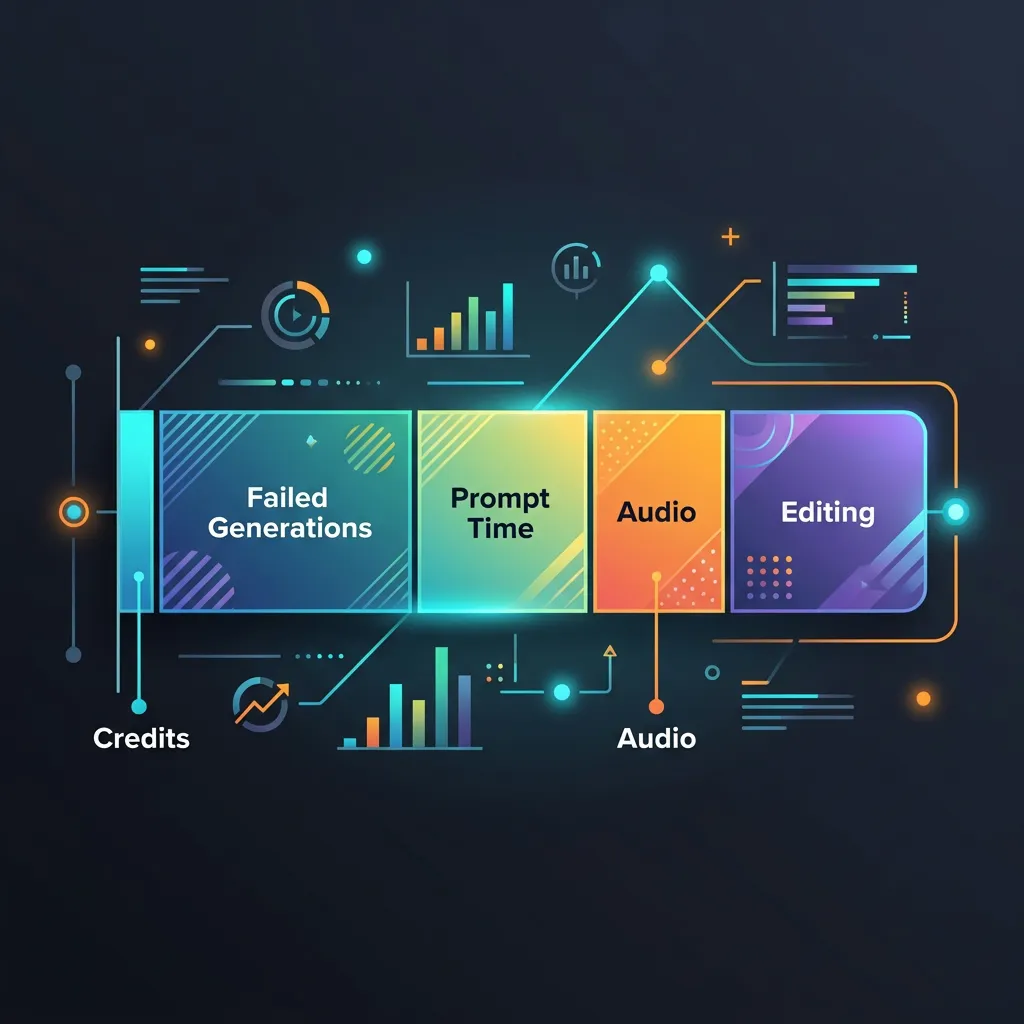
API credits: Video generation costs range widely by model. A 5-second clip on Seedance 1.5 Pro runs $0.04 to $0.14. The same clip on Kling 3.0 costs $0.50 to $1.00. Premium models like Veo 3.1 Quality run $0.60 per generation. For a 15-second ad requiring 3 to 5 clips, raw API costs land between $1 and $5 depending on the model.
Failed generations: Practitioners report that roughly 1 in 3 clips come out usable. One creator documented generating 1,200 clips and keeping 240 of them, an 80% discard rate. That means generating 9 to 15 clips to get 3 keepers. Real API cost: roughly 3x your initial estimate.
Prompt iteration time: Practitioners typically spend significant time writing, testing, and refining prompts before getting consistent results. At any reasonable hourly rate, this is the largest hidden cost.
Audio production: AI video models generate visuals only. Voice, music, and sound effects require separate tools (ElevenLabs, Google Lyria 3, or stock audio). This adds to the per-ad cost depending on quality requirements.
Editing and assembly: Cutting clips together, timing audio, adding text overlays. Even with AI-assisted editing, assembly takes real time for each ad.
Realistic total for one 15-second ad: practitioners report $30 to $50 in combined cost and time.
That is not $10. But it is also not $5,000. The real story is more interesting than either extreme.
The Failure Rate Nobody Mentions
The demos you see on Twitter are a highlight reel. Every impressive AI ad compilation is the result of dozens of generations where most were unusable.
One ad creator documented generating 1,200 clips across a campaign and keeping 240, an 80% discard rate. The exact usable rate varies by practitioner, but the pattern is consistent: most generations are not production-ready.
This is not a criticism of the technology. It is a production reality that changes how you plan and budget. If you budget for 3 generations and need 3 clips, you will come up short. Budget for 10 generations and you will have options.
The failure rate also varies dramatically by content type:
Higher success rate: Product shots on solid backgrounds, simple camera movements, abstract or stylized visuals. These are the easiest scenes for current models.
Moderate success rate: Character-driven scenes, specific camera angles, scenes with text or logos. Expect to generate several versions before getting a usable take.
Low success rate: Multi-character dialogue, specific lip sync, precise hand interactions, scenes requiring exact brand guidelines. These are where most of the wasted generations pile up.
Match Format to Model Capability
This is the insight that separates practitioners who ship ads from those who give up after a weekend: AI video ads work when you match the format to what the models can actually do.
15-second product ads work right now. Simple product reveals, lifestyle B-roll, and abstract brand spots are well within what current models handle. The format is short enough that minor artifacts do not compound, and the editing window is tight enough that viewers do not notice imperfections.
60-second narrative ads do not work yet. The moment you need consistent characters across multiple shots, matching lighting between scenes, or coherent dialogue with lip sync, the failure rate spikes and the iteration cost makes traditional production cheaper.
The iteration count is a scope problem, not a capability failure. Current AI video models can produce broadcast-quality individual shots. They cannot yet produce broadcast-quality sequences.
This means the winning formula is not "replace your production pipeline with AI." It is "use AI for the formats it handles well, and test volume."
The Volume Testing Workflow That Actually Works
Here is where AI video ads deliver real value, and it is not the $10 ad. It is the ability to test 20 variations instead of 2.
The workflow that ad buyers are actually using:
-
Generate 15-second product clips. Simple, focused, one product per clip. Use Seedance or Kling 3.0 for motion, or image-to-video for product reveals.
-
Create 20 variations. Same product, different angles, backgrounds, camera movements, and music. Total generation cost depends on model choice: under $10 on budget models like Seedance 1.5 Pro, $40 to $60 on mid-range models like Kling 3.0 (accounting for failed generations).
-
Run all 20 as Meta or TikTok ad variants. Let the platform algorithm pick the winner based on actual performance data.
-
Scale the winners. Once you know which visual style, angle, and pacing converts, generate more in that style.
This approach works because it plays to AI's actual strength: speed and variation, not perfection. A traditional video production typically starts at $1,000 to $5,000 per finished video, according to production agencies like Advids and vidBoard. An AI workflow creates 20 variations for a fraction of that in API costs plus a day of work.
The savings are not in the cost per ad. They are in the cost per insight about what actually converts.
Who This Is Actually For
The "$10 ad" narrative implies AI replaces professional ad production. It does not. It serves a different market entirely.
Small brands going from zero to something. Game developers who need a launch trailer but have no video budget. YouTubers who want channel ads. Shopify stores that need product demos. These creators were never going to hire an agency. Their alternative was no video at all.
Performance marketers testing creative. Ad buyers who need high-volume creative testing. The goal is not one perfect ad, it is finding which of 20 concepts resonates with the audience.
Internal teams prototyping concepts. Marketing teams creating rough cuts to align stakeholders before committing to a production budget. AI-generated storyboards and concept videos replace slide decks.
If you are producing Super Bowl spots or cinematic brand films, AI video is not replacing your process. If you are a solo founder who needs product clips for TikTok ads, this is transformative.
The Multi-Tool Reality
No single AI model handles the full ad production pipeline. Practitioners working with AI video ads are typically running three or more tools:
Visual generation: Seedance 2.0 for character motion and product demos, Kling 3.0 for physics-heavy scenes, Veo 3.1 for cinematic shots with native audio
Audio: ElevenLabs for voiceover, Google Lyria 3 for music, stock libraries for sound effects
Scripting: Large language models for ad copy variations and script generation
The real cost saving is not in API credits for any single tool. It is in eliminating the coordination overhead of hiring and managing three separate freelancers (videographer, voice talent, editor) for every creative test.
VicSee brings the visual generation piece together in one place, with access to Seedance, Kling 3.0, Veo 3.1, and image models for product shots and storyboard frames. New accounts get free credits, no credit card required.
Try it now: AI Video Generator | Seedance 2.0 | Kling 3.0
What to Expect in 6 Months
The failure rate is improving with each model generation. Features like Seedance 2.0's omni reference are solving the character consistency problem that made multi-shot ads impractical. Native audio in Veo 3.1 eliminates one tool from the pipeline entirely.
The direction is clear, even if the timeline is uncertain:
- Character consistency across shots is getting solved (omni reference, start/end frame control)
- Lip sync quality is improving rapidly, approaching social ad quality
- Audio is being integrated directly into video models (reducing the multi-tool overhead)
- API pricing continues to drop as competition increases between providers
The "$10 ad" is still a myth today. But "20 ad variations for under $100 in API credits" is real right now, and that is the number that actually matters for performance marketing.
FAQ
How much does an AI video ad actually cost?
Practitioners report a single 15-second AI video ad costs $30 to $50 when you account for API credits, failed generations, prompt iteration time, audio production, and editing. Raw API credits for 3 to 5 video clips range from $1 to $5 depending on the model, but most generations are discarded, and the total production time adds up. The real value is in testing 20 variations for under $100 in API credits rather than optimizing the cost of one ad.
Which AI model is best for video ads?
It depends on the ad type. Seedance 2.0 handles character motion and product demos well. Kling 3.0 excels at physics-heavy scenes and has reliable multi-shot capabilities. Veo 3.1 produces cinematic quality with native audio, reducing the need for separate voice tools. Most practitioners use 2 to 3 models depending on the scene requirements.
Can AI replace a video production agency?
Not for complex campaigns, brand films, or anything requiring precise brand guidelines, talent, and specific locations. AI video ads work best for high-volume creative testing (20+ variations), quick product demos, and social media ad content. The target market is brands that would otherwise have no video budget, not brands replacing existing production teams.
What is the failure rate for AI-generated video ads?
Most generated clips are not usable for production. One practitioner documented an 80% discard rate across 1,200 generations. The rate varies by complexity: simple product shots on solid backgrounds have a much higher success rate, while multi-character dialogue scenes waste the most generations. Budget for at least 3x the generations you think you need.
Is the 15-second format the only one that works?
15-second ads are the sweet spot because they are short enough to avoid compounding artifacts across multiple shots. 6-second bumper ads also work well. 30-second ads are possible with careful planning (5 to 6 separate clips edited together). 60-second narrative ads with consistent characters remain difficult and expensive due to cross-shot consistency challenges.
VicSee gives you access to the leading AI video models, including Seedance 2.0, Kling 3.0, and Veo 3.1, all in one platform. Whether you are testing ad variations or creating product demos, you can generate, compare, and iterate without switching between tools. New accounts get free credits, no credit card required.